

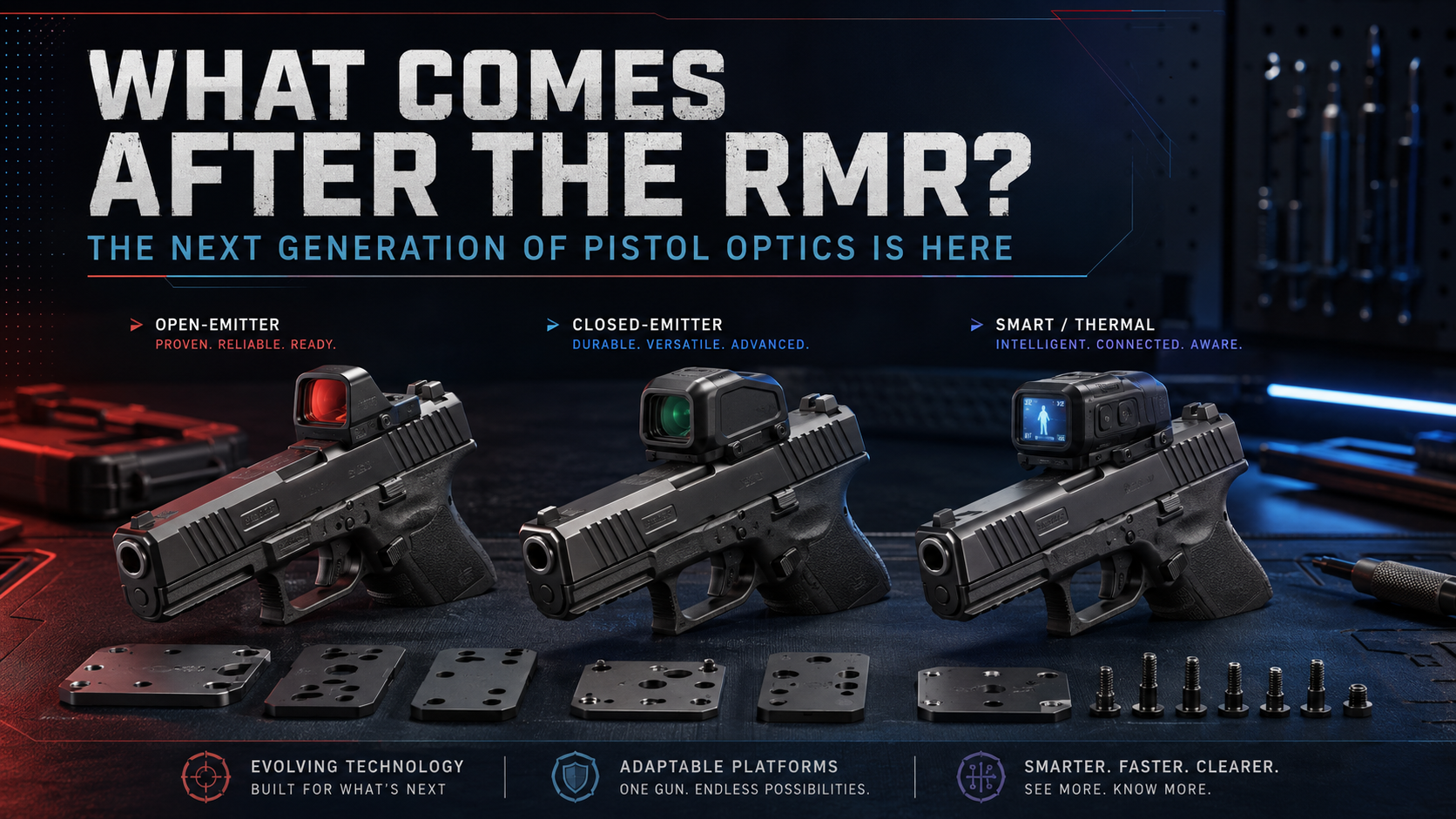
What Comes After the RMR? The Next Generation of Pistol Optics Is Here
1. Enclosed Emitters Are Becoming the New Normal
One of the biggest changes in handgun optics is the move toward enclosed-emitter red dots.
Traditional open-emitter optics leave the LED emitter exposed inside the optic housing. That design has worked extremely well for years, but enclosed optics place the emitter inside a sealed housing.
Why does that matter?
An enclosed design can help keep dirt, dust, rain, lint, and other debris away from the emitter. For someone carrying a handgun regularly, using one outdoors, or simply wanting an optic that requires less attention, that can be attractive.
The tradeoff is usually additional size, weight, and sometimes cost.
What was once a fairly specialized category is quickly becoming mainstream. More manufacturers are introducing compact enclosed optics, and customers are beginning to ask whether they should buy an open-emitter optic at all.
Our answer?
It depends on how you're going to use it.
Open-emitter optics are still compact, proven, and often more affordable. Enclosed optics simply provide another option for customers who prioritize environmental protection and durability.
2. The Mounting-System Battle Is Getting Interesting
Ask anyone who has shopped for a pistol optic recently and you've probably heard the same alphabet soup:
RMR. RMSc. ACRO. DeltaPoint Pro. MOS.
The number of mounting footprints has become one of the most confusing parts of buying a pistol optic.
For years, adapter plates have helped solve that problem. A handgun can use one mounting system, while different plates allow it to accept several optic footprints.
The downside?
Plates can add height and additional components between the optic and the slide.
That's why we're beginning to see manufacturers experiment with better direct-mount and multi-footprint solutions.
The goal is simple: mount the optic lower while giving customers more choices.
That's important because the future of pistol optics may not revolve around one universal footprint. Instead, we could see mounting systems become more adaptable so the gun isn't permanently tied to one optic family.
For consumers, that could mean easier upgrades later.
And considering how quickly optic technology is changing, upgradeability could become a major selling point.
3. Pistol Optics Are Getting Smarter
The first generation of pistol red dots had one primary job:
Put a dot on the target.
Today's optics can do considerably more.
Depending on the model, we're now seeing features such as:
- Automatic brightness adjustment
- Shake-awake or motion activation
- Multiple reticle choices
- Solar-assisted power
- Automatic shutoff
- Rechargeable batteries
- Larger information displays
- Rangefinding technology
- Digital imaging
Individually, none of those features completely changes the red-dot market.
Together, they show where the industry is headed.
The optic is slowly evolving from a simple illuminated aiming device into a small electronic platform.
Think about smartphones.
The first models handled calls, text messages, and basic internet access. Over time, manufacturers kept packing additional technology into the same basic footprint.
We're starting to see something similar happen with optics.
4. Thermal Imaging Is Shrinking to Red-Dot Size
This may be the most interesting development of all.
Thermal technology is getting small.
Not long ago, most people pictured a large rifle-mounted scope when they heard the words "thermal optic."
That's changing.
Manufacturers are now producing miniature thermal devices approaching the size and form factor of traditional pistol optics, including models designed around familiar mounting footprints such as the RMR pattern.
Some combine a traditional visible aiming system with thermal imaging. Others function primarily as compact thermal sights.
Are miniature thermal pistol optics going to replace red dots anytime soon?
Probably not.
But that's almost beside the point.
The significance is that thermal sensors, processors, displays, and batteries have become small enough for manufacturers to seriously experiment with this format.
Today's miniature thermal optic may be a niche product.
Five years from now, the technology could look completely different.
That makes this category one of the most interesting areas of the optics industry to watch.
5. Holographic Technology Is Moving Smaller
Another interesting development is the continued miniaturization of holographic sight technology.
Most shooters associate holographic sights with larger rifle optics. Traditional pistol dots, by comparison, generally use LED-reflex technology.
Newer designs are beginning to challenge that distinction.
If manufacturers can successfully package holographic technology into durable handgun-sized optics, consumers could eventually have another major category to choose from alongside open-emitter and enclosed-emitter LED dots.
That's good for the customer.
Competition between technologies typically means more choices, improved features, and manufacturers fighting harder for your dollar.
6. Bigger Windows Without Bigger Bricks
Another trend we're watching is window size.
Customers like large optic windows because they're easy to see through and make the dot easier to pick up.
But nobody wants a massive piece of equipment sitting on top of a compact handgun.
Manufacturers are therefore trying to maximize usable viewing area without dramatically increasing the overall footprint of the optic.
That means thinner housings, redesigned electronics, improved lens geometry, and more efficient packaging.
This might not sound as exciting as thermal imaging or smart electronics, but it's one of the improvements customers notice immediately when comparing optics side by side.
Is the Traditional RMR Going Away?
No.
In fact, the RMR footprint itself remains extremely important precisely because so many guns, slides, mounts, and accessories already support it.
Proven technology doesn't suddenly become bad technology because something newer appears.
What is changing is the number of alternatives.
A customer shopping for a pistol optic today can consider factors that barely existed a few years ago:
Open or enclosed?
Direct mount or adapter plate?
Standard dot or multi-reticle?
Traditional LED or something more advanced?
Basic optic or smart optic?
And now, in some cases:
Do I want thermal capability?
That's a very different marketplace than the one that existed when pistol red dots first started gaining widespread popularity.
What Should You Buy?
Don't buy an optic simply because it's the newest thing on the internet.
Start with what you actually want the optic to do.
For many people, a quality traditional red dot remains the best combination of simplicity, size, reliability, and price.
If the optic will frequently be exposed to dirt, weather, or everyday carry conditions, an enclosed emitter may be worth considering.
If you enjoy cutting-edge technology, miniature thermal and smart optics are becoming increasingly interesting.
And if you're buying an optics-ready handgun, don't overlook the mounting system. The footprint you choose today can affect your upgrade options tomorrow.
The Future of Pistol Optics Is Just Getting Started
The most exciting thing happening in pistol optics isn't one particular model or brand.
It's how quickly the entire category is evolving.
Red dots aren't disappearing.
They're becoming enclosed, smarter, smaller, more adaptable, and—in some cases—thermal.
The traditional RMR helped establish what a modern pistol optic could be.
The next generation is asking a different question:
What else can we fit up there?
If you haven't looked at pistol optics recently, stop by The Gun Shoppe of Sarasota and take a look at what's changing. Seeing the different sizes, footprints, window designs, and technologies side by side can make choosing the right optic considerably easier.


